In the late 1990s and early 2000s, long before toddlers routinely swiped through YouTube Shorts on an iPad, a very different kind of screenless interactive gadget captured the hearts of parents and children alike. The device was the LeapPad, an innovative paper-and-stylus learning board created by educational entertainment firm LeapFrog. For years, the LeapPad was not merely a popular toy—it was a bona fide cultural phenomenon, topping holiday wishlists and redefining how technology could be introduced into early childhood education.
Yet today, the LeapPad exists primarily as a nostalgia artifact for Generation Z and younger Millennials. The arrival of multi-touch consumer tablets, spearheaded by Apple’s iPad in 2010, rapidly altered the landscape of youth media consumption. Understanding the rise, reign, and eventual decline of the LeapPad reveals critical insights into hardware design, educational software economics, and the ongoing debate surrounding kids and screen time.
The Invention of an Educational Titan
To understand the LeapPad’s impact, one must look at the consumer tech landscape of 1999. Home computers were bulky, expensive, and largely placed in dedicated office rooms. Mobile technology consisted of basic feature phones, handheld electronic games with monochrome LCD displays, and early personal digital assistants like the Palm Pilot. For young children learning to read, interactive technology was mostly restricted to desktop CD-ROMs like Living Books or Reader Rabbit.
LeapFrog, founded in the mid-1990s by Michael Wood, sought to bridge the gap between physical books and audio feedback. Wood had developed tactile phonics toys to help his son learn to read, culminating in the invention of the NearTouch technology that powered the original LeapPad.
The genius of the original LeapPad lay in its clever fusion of physical print and concealed electronics. The device itself was a plastic fold-out binder featuring a built-in speaker and an attached stylus. Users would place a specially printed, spiral-bound book onto the tray and insert a matching plastic ROM cartridge into a side slot. Beneath the tray lay a grid of capacitive or pressure-sensitive sensors. When a child pressed the stylus onto a word, picture, or character in the printed book, the board detected the exact spatial coordinates and played corresponding audio files from the cartridge.
This hybrid approach created a uniquely engaging interface. Children were not staring at an emissive screen; they were looking at traditional paper illustrations. Yet, tapping a word would cause a clear, synthesized voice to pronounce it, sound out individual phonics, or play musical accompaniment. It transformed static reading into an active, self-guided experience.
Why Parents and Kids Loved It
For parents, the LeapPad hit a sweet spot that few modern gadgets manage to achieve. It was undeniably educational, backed by phonics research, and designed explicitly to encourage literacy. Unlike video games, which carried a stigma of mindless entertainment, the LeapPad felt like a wholesome investment in a child's academic future.
It also solved a persistent practical problem for families: long car rides and quiet play time. The device provided hours of structured, independent activity without requiring supervision or constant parental intervention. The physical durability of the hardware—built with thick plastics designed to survive drops, spills, and rough handling—further cemented its reputation as a reliable utility for households with young kids.
For children, the magic was the direct agency it offered. Being able to touch any part of a page and receive immediate audio feedback made reading feel like unlocking hidden secrets. Furthermore, LeapFrog aggressively licensed popular media franchises. Children could practice reading alongside characters from Disney, Pixar, Sesame Street, and Arthur. This combination of high-profile characters and interactive storytelling made the LeapPad one of the most requested holiday toys for several consecutive years in the early 2000s.
The Software Business Model and Hardware Limits
From a business perspective, the original LeapPad was a classic 'razor and blades' strategy. The main unit was priced reasonably enough to drive high household penetration. Once a family owned the base station, LeapFrog could sell an ongoing ecosystem of books and software cartridges priced between $15 and $25 each.
This economic engine propelled LeapFrog to massive market share in the early educational technology sector. However, the system's reliance on custom physical media also highlighted its inherent limitations as consumer electronics evolved:
- Physical Logistics: Every single book required its own matching plastic ROM cartridge. Losing a cartridge rendered the corresponding book useless, leading to cluttered living rooms and frustrated parents.
- Fixed Asset Constraints: The content printed on the page was fixed. Once a child exhausted the interactive hotspots in a given book, there were no dynamic updates or algorithmic variations.
- Manufacturing Costs: Producing physical paper books alongside custom plastic cartridges carried heavy inventory and supply-chain overhead compared to pure software distribution.
As the mid-2000s approached, LeapFrog attempted to modernize the platform. They introduced the Quantum LeapPad for older kids, the My First LeapPad for toddlers, and the Leapster—a dedicated handheld video game console aimed at blending gaming with educational content. While these products performed well, the foundational underlying technology was aging rapidly.
The iPad Disruption and the Shift to Digital Touch
In April 2010, Apple introduced the iPad. Although Steve Jobs initially pitched the device as a lean-back web browser and media consumption tablet for adults, parents almost immediately discovered its utility as a pacifier and entertainment hub for young children.
The iPad fundamentally altered the economics and user experience of children's software. Suddenly, a single glass screen could display infinite full-color animations, stream high-definition video, and host thousands of interactive apps available instantly via the App Store—often for free or for just a few dollars.
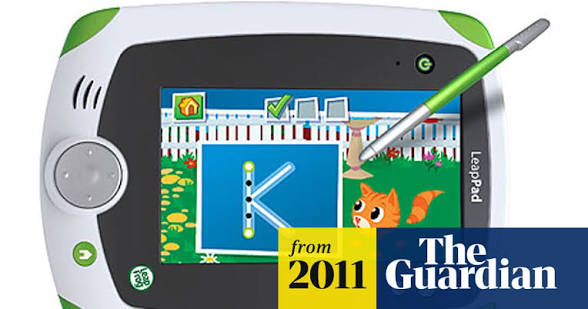
LeapFrog tried to counter this existential threat by pivoting the LeapPad brand into a true tablet form factor. In 2011, the company launched the LeapPad Explorer, a ruggedized, Android-derived child's tablet with a resistive touchscreen, built-in apps, and a curated app store. Unlike standard consumer tablets, the LeapPad Explorer featured robust parental controls, a walled-garden software environment, and a drop-tested casing.
For a brief period, this tablet pivot was a massive commercial hit. The LeapPad Explorer became one of the top-selling toys of the 2011 holiday season, proving that parents still desired a dedicated, safe environment for their children rather than handing over a fragile, expensive iPad.
However, the platform could not sustain its momentum against the broader consumer tech ecosystem:
- Hardware Performance Gap: To keep prices low (typically around $100), dedicated kid tablets relied on slow processors, low-resolution resistive touchscreens that required pressure or a stylus, and limited storage. Kids raised on the smooth, capacitive glass screens of their parents' smartphones found these devices clunky and unresponsive.
- App Ecosystem Disparity: While LeapFrog sold curated educational software titles for $20 to $30, the iOS App Store and Google Play offered thousands of polished games like Angry Birds or early educational software for free or a fraction of the cost.
- The Rise of Universal Media Platforms: Children's media consumption shifted rapidly from interactive learning activities toward streaming video on platforms like YouTube and Netflix. A restricted device that could not easily stream modern video content felt increasingly obsolete to younger viewers.
By the mid-2010s, parent preferences had shifted. Rather than buying a standalone, underpowered kid tablet that a child would outgrow in two years, parents increasingly opted to pass down their older iPhones or iPads, protecting them with heavy-duty rubber cases and setting up built-in parental restrictions.
The Legacy of the LeapPad
LeapFrog’s ultimate destiny mirrored that of many single-purpose hardware makers in the smartphone era. Facing declining sales and intense pressure from broader hardware manufacturers, LeapFrog was acquired by VTech in 2016. Today, the LeapFrog brand survives as an imprint for early childhood toys and specialized learning gadgets, but its dominance over the tech landscape is a thing of the past.
Looking back, the original LeapPad remains an extraordinary chapter in modern consumer tech history. It successfully demonstrated that interactive digital media could be seamlessly paired with physical print to aid child literacy. It challenged educators and engineers to think critically about how software interfaces should be structured for developing minds long before 'UI/UX' became mainstream buzzwords.
Moreover, the story of the LeapPad serves as a poignant reminder of a unique transitional era in computing—a period when technology enhanced physical objects rather than replacing them entirely with hyper-stimulating glass screens. As modern parents increasingly grapple with screen time addiction, blue light concerns, and the infinite scroll of mobile algorithms, the simple, focused, paper-based design of the original 1999 LeapPad looks less like an ancient relic and more like a thoughtful paradigm that contemporary tech has yet to truly replace.