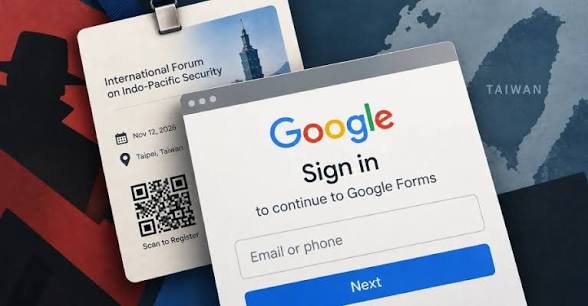
A Precision Strike on Academic and Strategic Expertise
Cybersecurity intelligence teams have uncovered a sophisticated spear-phishing initiative directed at academic, technological, and policy researchers affiliated with Taiwanese organizations. Tracked under the placeholder identifier UAT-11985, this adversary set leverages a blend of social engineering and advanced proxy architecture to compromise targets. Rather than relying on generic spam or crude malware attachments, the threat actors rely on high-context event invitations that mirror legitimate academic symposiums, international tech forums, and regional security seminars.
Taiwan's position at the heart of global semiconductor manufacturing and geopolitical friction makes its research ecosystem a high-value target for state-sponsored espionage groups. By targeting individuals affiliated with prominent think tanks, universities, and research institutes, UAT-11985 aims to secure persistent access to sensitive intellectual property, diplomatic insights, and strategic communications. The refined nature of this operation highlights how cyber espionage campaigns have adapted to modern defense postures, specifically bypassing standard email security gateways and basic multi-factor authentication (MFA) mechanisms.
Anatomy of the Attack: Fake Invites and Calendar Abuse
The initial access phase of the campaign relies heavily on trust exploitation. Victims receive meticulously crafted email communications or calendar invites purporting to come from trusted peers, international research foundations, or event organizers. These invitations often reference upcoming conferences, panel discussions, or collaborative publications that align directly with the victim's precise field of study.
Embedded within these communications are links that appear to lead to event registration pages, document-sharing portals, or pre-conference survey forms. In many instances, the threat actors abuse legitimate cloud services, such as Google Workspace tools or trusted short links, to host initial redirection stages. Because these domains carry high reputation scores across automated security filters, the phishing emails regularly land in the victim's primary inbox rather than being flagged as spam or malicious.
Once a target clicks on the embedded link, they are not presented with a static, obviously fake login page. Instead, the infrastructure seamlessly routes them through a series of dynamic checks designed to filter out security crawlers and sandbox environments before presenting the final payload.
Breaking MFA with Adversary-in-the-Middle (AitM) Architecture
The core technical engine behind this campaign is an Adversary-in-the-Middle (AitM) phishing framework. Traditional phishing setups rely on static clone pages that capture username and password combinations entered by the victim. However, as organizations across Taiwan and the global research sector have widely adopted multi-factor authentication, simple credential harvesting is no longer sufficient for threat actors seeking account access.
An AitM architecture solves this problem for the attacker by acting as a live reverse proxy positioned between the victim and the actual, legitimate authentication server (in this case, Google's sign-in infrastructure).
When the victim interacts with the phishing site, the workflow unfolds in real time:
- Proxy Request Relay: The victim accesses the attacker-controlled proxy domain, which fetches the live, authentic Google login page in the background and presents it to the user.
- Credential Capture: The user enters their legitimate Google username and password into what is effectively a real login form being proxied by the adversary.
- MFA Interception: When Google prompts the user for a multi-factor authentication code—whether an SMS OTP, an authenticator app code, or a push notification—the proxy forwards this prompt to the user and passes their response back to Google.
- Session Hijacking: Upon successful authentication, Google issues dynamic session cookies (such as SID, HSID, and SSID) to establish the logged-in session. The AitM framework intercepts these session tokens, saves them for the attacker, and then redirects the victim to a legitimate document or event page to avoid raising suspicion.
By stealing the authenticated session cookies rather than just the static password, UAT-11985 effectively bypasses standard multi-factor authentication. Armed with these session tokens, the attackers can inject them into their own web browsers, instantly gaining full access to the victim's Google account—including Gmail, Drive, Docs, and contacts—without ever triggering a secondary MFA prompt.
Strategic Importance of the Target Base
The focus on Taiwanese research affiliates reflects broader geopolitical dynamics in the Indo-Pacific region. Threat actors conducting state-aligned espionage frequently target non-governmental entities, academic personnel, and independent policy experts because these individuals often possess crucial insights while operating under less stringent cybersecurity controls than core military or defense agency networks.
Researchers and academics frequently correspond with foreign diplomats, government officials, corporate executives, and defense analysts. Compromising a single high-profile academic's Google Workspace can yield a treasure trove of sensitive draft papers, private policy recommendations, and unannounced technological developments. Furthermore, an attacker can use a compromised researcher's legitimate Gmail account to launch secondary spear-phishing attacks against even higher-value targets, exploiting the established trust of the stolen identity.
The Evolution of Google-Centric Phishing Infrastructure
Google Workspace accounts have become primary targets for persistent threat groups due to their central role in professional workflows. Access to a primary Google account frequently unlocks single sign-on (SSO) entry into dozens of third-party SaaS platforms, code repositories, and corporate management portals.
UAT-11985's deployment of AitM tooling against Google accounts mirrors a broader shift across the cyber threat landscape. Off-the-shelf frameworks such as Evilginx, Muraena, and Modlishka have lowered the technical barrier to entry for executing AitM attacks. While UAT-11985 utilizes tailored infrastructure to evade basic signatures, the core design principles remain rooted in live session proxying.
Detecting AitM operations poses significant challenges for standard security controls:
- Valid TLS Certificates: Attackers automatically provision legitimate Let's Encrypt or zero-cost TLS certificates for their proxy domains, ensuring victims see the familiar padlock icon in their browser address bar.
- Domain Typosquatting: Domains used in the campaign frequently blend terminology related to academic research, event management, or Google service endpoints, making them visually convincing to end users.
- Real-time Forwarding: Because the content being served is fetched directly from Google's real servers, visual anomalies, outdated logos, or broken login flows are entirely absent.
Mitigating the Threat: Beyond Traditional MFA
This campaign serves as a stark reminder that traditional forms of multi-factor authentication—such as SMS passcodes, time-based one-time passwords (TOTP) from apps like Google Authenticator, and push-to-accept notifications—are no longer sufficient to stop determined APT groups utilizing AitM setups.
To counter AitM phishing effectively, organizations must migrate toward phishing-resistant MFA standards, primarily those built on FIDO2 and WebAuthn frameworks.
Hardware Security Keys
Hardware keys (such as YubiKeys or Titan Security Keys) binding authentication to the specific domain origin in the browser address bar are immune to AitM proxying. During a FIDO2 authentication flow, the browser passes the actual origin domain (e.g., phishing-domain.com) to the token. The token compares this against the registered domain (accounts.google.com) and refuses to sign the authentication request if a mismatch is detected.
Passkeys
Passkeys leverage the same underlying WebAuthn technology, integrating origin-bound cryptographic keys directly into user devices, operating systems, and password managers. Implementing passkeys across enterprise Google Workspace deployments prevents users from authenticating on proxy domains.
Conditional Access and Device Posture Checks
In addition to upgrading MFA protocols, security teams targeting threats like UAT-11985 should enforce strict conditional access policies. By restricting account access based on trusted device certificates, managed IP ranges, and compliance states, organizations can ensure that stolen session cookies cannot be successfully replayed from an attacker's infrastructure.
Continuous Session Monitoring and Identity Threat Detection
Security operations centers (SOCs) must monitor for anomalous session activity, such as rapid geographic travel (impossible travel velocity), sudden changes in user-agent strings mid-session, or logins originating from known cloud proxy providers. Google Workspace admins should leverage Context-Aware Access controls to continuously validate user context beyond initial login.
What Lies Ahead
As UAT-11985 and similar threat groups refine their operational security and technical toolsets, the line between social engineering and complex infrastructure exploitation will continue to blur. The targeting of Taiwanese research institutions demonstrates that non-profit, academic, and policy sectors must be treated as critical national infrastructure from a defense perspective.
Organizations operating in high-risk regions or sensitive sectors must treat credential management as an evolving discipline. Relying on legacy MFA solutions creates a false sense of security in an era where AitM automation is widely available to sophisticated adversaries. Upgrading to domain-bound, phishing-resistant authentication, hardening Google Workspace environments, and fostering high security awareness among research staff remain the vital pillars for neutralizing this ongoing threat.